date: 2024-04-07
title: Graph-algorithm
status: UNFINISHED
author:
  - AllenYGY
tags:
  - Graph
  - Algorithm
  - NOTE
created: 2024-04-07T22:33
updated: 2024-04-15T13:24
publish: True
Graph-algorithm
A graph is a pair of
V is the collection of vertices
E is the collection of edges
(u, v) and (v, u) are distinct for some edges (u, v)
(u, v) and (v, u) are identical for all edges (u, v)
Graph Representation
Adjacency list Representation
- In directed graphs,
Adjacency matrix Representation
DFS Algorithm
- Traverse all vertices in graph, and thereby
- Reveal properties of the graph.
Four array s are used to keep information gathered during traversal.
- white: undiscovered
- gray : discovered but not finished processing
- black: finished processing
- a counter indicating when vertex u is discovered
- a counter indicating when the processing of vertex
- a counter indicating when the processing of vertex
Algorithm DFS(G)
Input: Graph G
Output: Vertex traversal of graph G
for all vertex u∈V(G) do
color[u]←white//Initialize
pred[u]←NULL
end for
time←0
for all vertex u∈V(G) do//Start a new tree
if color[u]==white then
DFSVisit(u)
end if
end for
Algorithm DFSVisit
color[u]←gray//u is discovered
d[u]←++time//u's discovery time
for all v∈adj[u] do//Visit undiscovered vertex
if color[v]==white then
pred[v]←u
DFSVisit(v)
end if
end for
color[u]←black//u has finished
f[u]←++time//u finish time
- The time stamp arrays: d[v], f[v]
- The predecessor array: pred[v]
Use
It is a graph with no cycles, and a collection of trees.
If G=(V, E) is an undirected graph
DFS Time Analysisi
DFS Properties
Time Time-Stamp Structure
- u is a descendant ( in DFS trees ) of v, if and only if
- u is an ancestor of v, if and only if
- u is unrelated to v, if and only if
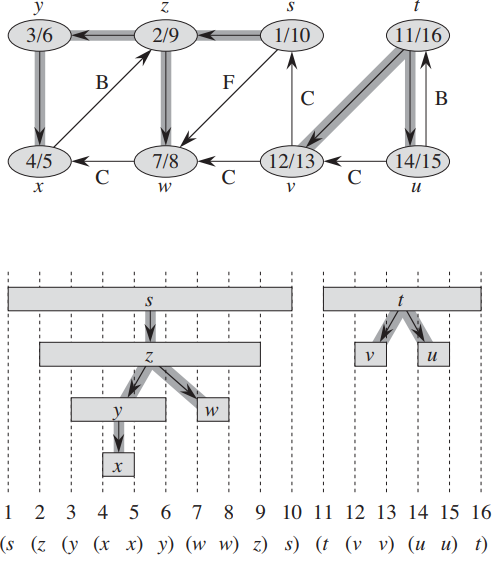
The idea is to consider every case.
Assume
- If
- u is discovered when v is still not finished y et ( marked gray)
- u is discovered later than v
- hence we have
- u is discovered when v is still not finished y et ( marked gray)
- If
- Obviously
- Which means that when u or v is discovered, the others are not marked gray;
- And hence neither vertex is a descendant of the other
- Obviously
Tree Structure
An edge in an undirected graph is either a tree edge or a back edge.
Assume
Hence v is in the DFS subtree rooted at u.
- If
- If
Application
Articulation
Let G=(V, E) be a connected undirected graph.
An articulation point (cut vertex) of G is a vertex whose removal disconnects G
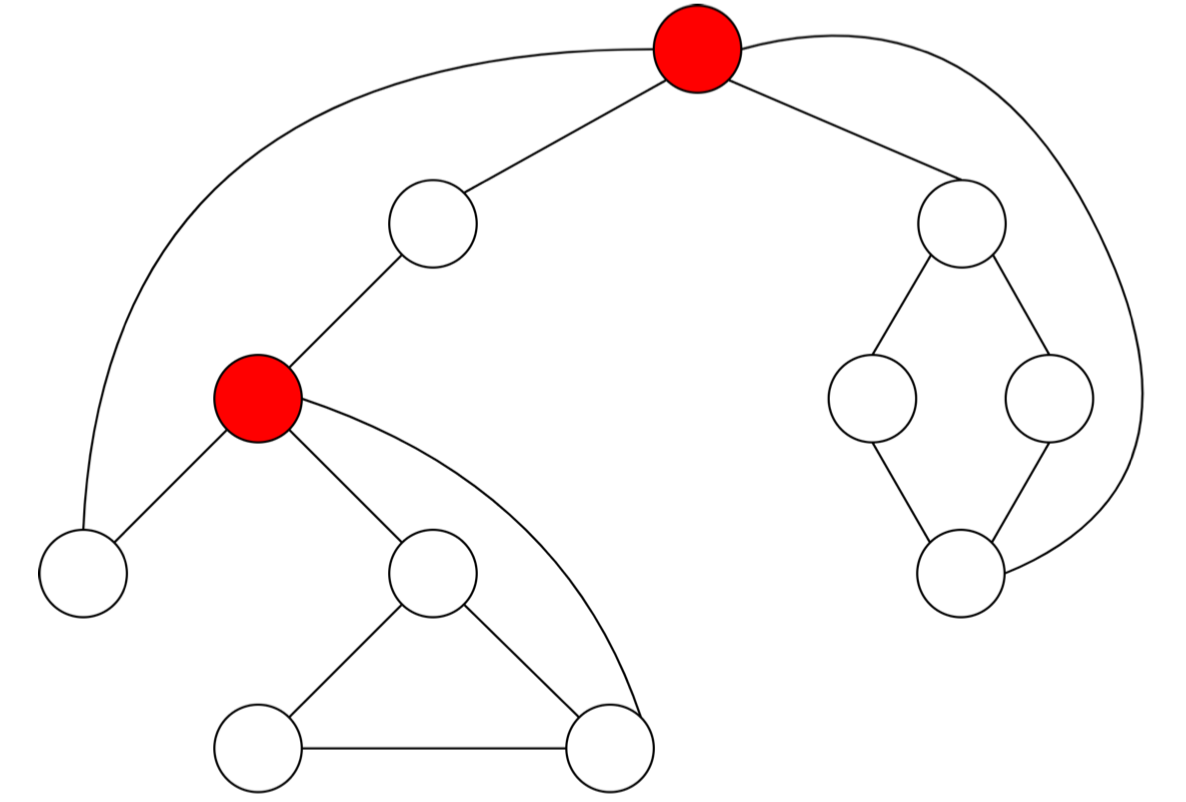
- Brute Force Solution
Brute Force Solution
- Remove a vertex and its corresponding edges one by one one from G.
- Test whether the resulting graph is still connected or not say by DFS.
The running time is O (n ∗(n + e)) .
Observations
- The root of the DFS tree is an articulation point if it has two or more children.
- A leaf of the DFS tree is not an articulation point.
- And for other internal vertex v in the DFS tree, v is an articulation point if
if there is one subtree rooted at a child of v that does not have a back edge which climbs higher than v.
Tackle Observation 3
Using the discovery time in the DFS tree to define low and high.
If there is a subtree rooted at a children of v which does not have a back edge connecting to a vertex with discovery time smaller than d[v] , then v is an articulation point.
- Let Low (w) be the smallest value that a descendant of w can climb up by a back edge.
- We use d[v] to express the “hight” of v.
- v is “higher” than u if v and u are on the same branch of the DFS tree and d[v] < d[u] .
- If v and u are on different branches, d[v] and d[u] are not compatible by the time-stamp structure.